
About the Department
The Centralized Sterilization Department is the structural subdivision of the Medical Centre Hospital of the President’s Affairs Administration of the Republic of Kazakhstan. The Central Sterilization Department is equipped with the latest technology, enabling an increased volume of disinfection and sterilization processes for medical instruments.
Goal of the Department
Centralization of the processing of medical devices subject to sterilization (use of reliable techniques of pre-sterilization treatment and sterilization, supervision of them).
Objectives of the Department
Provision of the Hospital with sterile medical accessories: surgical instruments, syringes, needles, catheters, bougies, surgical gloves, micropipets, dressing and suture materials, linen;
Practical application of advanced techniques of pre-sterilization cleaning, and sterilization.
Functions of the Department
1) receipt and storage before treatment of nonsterile articles used in departments and materials prepared for sterilization;
2) pre-sterilization cleaning (washing, drying);
3) sterilization of articles;
4) quality control of pre-sterilization treatment, sterilization of articles and registration of:
Results of accounting of quality of the pre-sterilization treatment of articles to eliminate blood and SAA (surface-active agents);
Results of the quality of work of sterilizers;
Results of sterility examination;
5) supply of departments of the Hospital with sterile articles.
Equipment of the Department
The Department has two automatic washing and disinfecting machines Miele and UNICLEAN (Germany).
Eight steam sterilizers with a chamber volume of 613.164 liters: Selectomat PL 6612-2V R and Sterivap PL (Germany).
FORMOMAT PL low temperature sterilizer (Germany).
STERRAD 100NX, STERRAD 100NX ASP, HMTS 142D, HMTS 80E plasma sterilizer.
Ultramatic 550/600 (2 units) Ultrasonic Cleaning System.
STERICELL SCS 111 (3 units) dry-heat sterilizer.
Sterilization is carried out in the low-temperature plasma sterilizer HMTS 142 D, which has no analogues in the Republic of Kazakhstan. This ensures the use of high-tech sterilization methods, which undoubtedly enhances the quality of medical services provided by the hospital.
The use of state-of-the-art equipment and the expansion of the scale of medical services contribute not only to increased operational efficiency but also to improving the overall health level of the population.
Low-temperature sterilizers MMM Formomat achieve sterilization through the action of active media (formaldehyde) at a specified temperature and exposure time. Typically, temperatures range from 40 °C to 75 °C with sterilization exposure times from 45 to 300 minutes, depending on the intended purpose.
The new series of MMM FORMOMAT devices incorporates technical solutions that optimize the low-temperature sterilization process for all types of medical devices, especially long hollow instruments, in terms of efficiency, technical design, and workflow organization. The FORMOMAT device offers a wide range of functions, including selectable temperatures (55 °C, 60 °C, 75 °C), easy operation via the advanced MMM control panel, comprehensive documentation, economical use of sterilizing agents, and process validation with load monitoring. The device is certified in accordance with European standards.
The new MMM FORMOMAT employs low-temperature formaldehyde sterilization at 55 °C, 60 °C, or 75 °C, making it suitable for processing all types of heat-sensitive materials. It can sterilize even very long and narrow hollow instruments. FORMOMAT is officially certified for sterilizing hollow instruments up to 1.5 m in length with an internal diameter of 2 mm using the standard cycle, even at 55 °C. Biological monitoring is performed with the same indicators used for steam sterilization. Thanks to its unique design—including external chamber heating jackets, door heating jackets, an external turbo fan, and a powerful vacuum system—FORMOMAT achieves excellent sterilization results without formaldehyde residues on the device or chamber walls. Sterilized instruments are ready for immediate use after the cycle; no additional aeration of the sterilized materials is required.
The STERRAD® 100NX® system is based on next-generation technology and represents the most advanced ASP sterilizer using hydrogen peroxide gas plasma. Key features include:
Large rectangular chamber and multiple cycle options for maximum throughput Standard 47-minute cycle suitable for most surgical instruments
Flex 42-minute cycle for single-channel flexible endoscopes
Express 24-minute cycle for rapid turnaround of da Vinci® 3-D endoscopes, rigid telescopes, batteries, and other instruments*
DUO 60-minute cycle for simultaneous processing of flexible endoscopes and cameras
Advanced capabilities provide ease of use and quality control, including a large touchscreen, innovative foot pedal for easier loading, hydrogen peroxide concentration sensor ensuring sufficient sterilant levels and guaranteed sterility (SAL 10⁻⁶), network connectivity for remote cycle monitoring, and more.
Advantages of next-generation sterilization
The STERRAD® 100NX® system uses next-generation (NeXt) sterilization technology with higher hydrogen peroxide concentration, allowing sterilization of narrower lumens with shorter cycles compared to the original STERRAD® 100S technology.
The system features a larger rectangular chamber for rapid, safe, and efficient processing of large instrument loads to meet increasing reprocessing demands.
It enables processing of narrower-lumen endoscopes, including single-channel stainless steel tubes with an internal diameter >0.7 mm and length up to 500 mm, as well as single-channel flexible polyethylene and Teflon® endoscopes with an internal diameter >1 mm and length up to 850 mm. Up to two single-channel flexible endoscopes can be processed per cycle.
The system incorporates the latest IT innovations, such as RFID chip cassettes, built-in USB port, and an optional independent monitoring system.
The foot pedal allows hands-free, comfortable opening and closing of the chamber door.
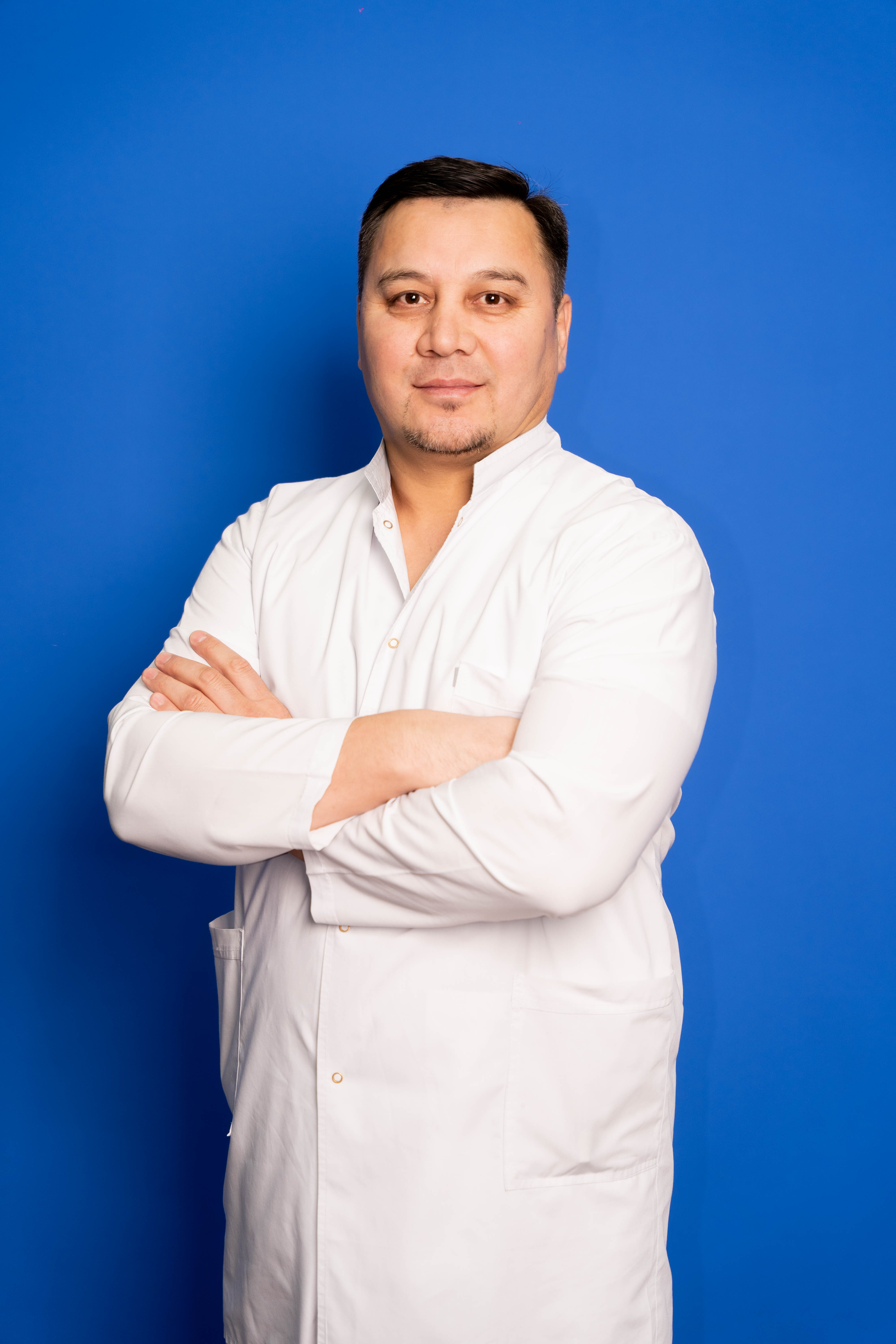 Yerkinbek Momynbekov
Chief of the Department
The Highest Category
Work experience 22 years